A step-by-step introduction to alpine skiing for first-time and beginner skiers
Book Structure Overview
Introduction
Learning to ski doesn’t have to be confusing, intimidating, or rushed. With the right information and a calm, step-by-step approach, skiing becomes predictable, manageable, and genuinely enjoyable.
This book is for first-time and beginner skiers — adults or kids — who want to understand skiing properly from the ground up. Whether this is your very first day on snow or you’ve tried skiing once or twice and still feel unsure, this guide is designed to meet you where you are.
You don’t need athletic talent, courage, or expensive equipment to start skiing. What you need is a clear understanding of how skis work, how to control speed, and how to move safely on the mountain. That’s exactly what this book provides.
Each chapter builds logically on the last, covering equipment, clothing, balance, stopping, turning, lifts, and safety — all explained in plain language, with no assumptions and no shortcuts.
Chapter 1: Understanding Ski Equipment
Before you ever slide downhill, it helps to understand the tools you’re standing on. Ski equipment may look complicated at first, but for beginners, the basics are simple.
1.1 Skis
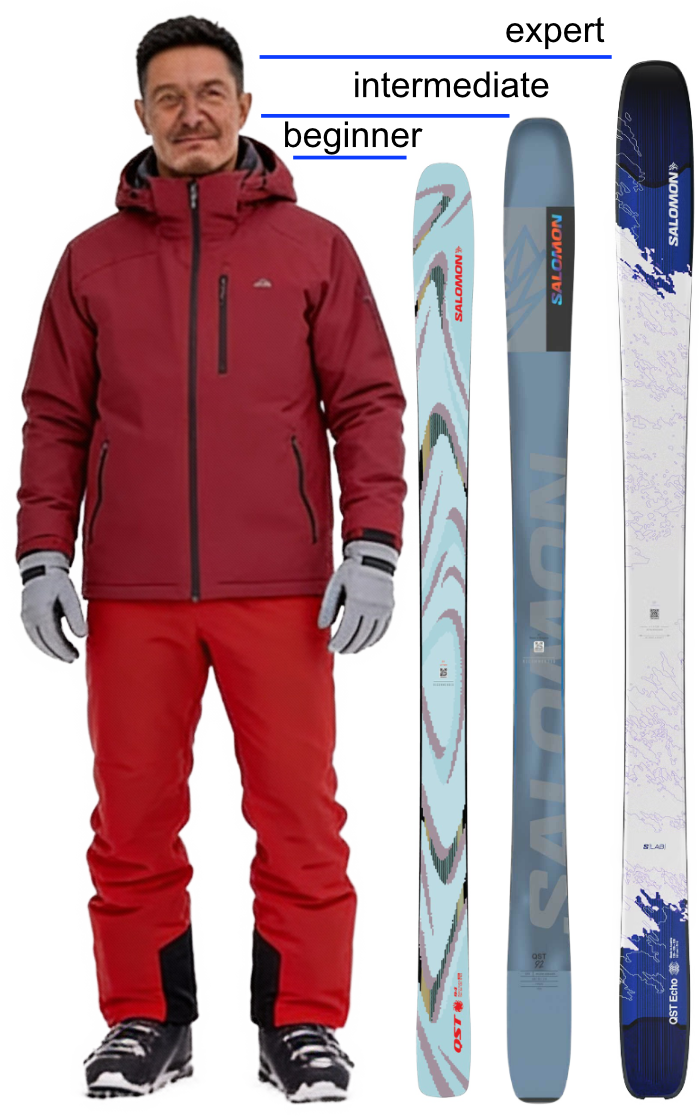
Skis are designed to slide forward, grip when edged, and turn when pressure is applied. There are 4 things to look for when choosing skis as follows for beginners:
- Ski length: Shorter are easier to handle. Shorter skis are easier to control and turn. For a beginner, a common rule of thumb is to choose a ski length at about the same height as your chin or nose. The shorter, the easier to handle. For intermediate ski,
- Ski flexibility: A soft ski is usually slow while a hard ski is faster and more stable at high speeds, something beginners don’t need yet.
- Shape of the ski: Beginners should choose skis with camber underfoot and gentle rocker at the tips. Watch this to give you an idea of the camber and rocker:
- Width of Ski: For learning on groomed slopes, choose skis with a waist width between 70 and 85 mm. Wider skis are designed for deep snow and advanced skiing.
Do not worry about brand names or graphics. The right size and type matters far more than how skis look.
Ski rental shops usually have a good stock of beginner skis. This is probably their largest market. The cosmetics on skis can obviously get scratched a lot but that doesn’t impact their quality or performance. Look at the base and edge of the skis. This is where you can tell if the shop is looking after them or not. There should be no large gouges in the base of the ski. Also, the steel edges should be intact; besides, this is what will help you turn eventually.
1.2 Boots
Boots are a very important piece of ski equipment.
Good beginner boots should:
- Fit snugly without pain
- Hold your heel firmly in place
- Allow you to bend your knees forward
What you are not looking for is “high performance” boots. These types of boots are still, hard to walk in and certainly not aimed at beginners.
Your toes may lightly touch the front when standing upright — this is normal. When you bend your knees, your toes should pull back slightly.
Most boots will come with a flex index created by the manufacturer.
If boots are uncomfortable, skiing will feel hard no matter how good your skis are. Spend some time fitting the right boot. Here is a chart to give you some ideas of what you should be targeting:
| Flex Rating | Who It’s For |
| 50–60 | First-timers, very light beginners |
| 60–80 | Beginner skiers |
| 80–100 | Intermediate skiers |
| 100–120 | Advanced skiers |
| 120–140 | Expert and aggressive skiers |
| 140+ | Race-level and professional skiers |
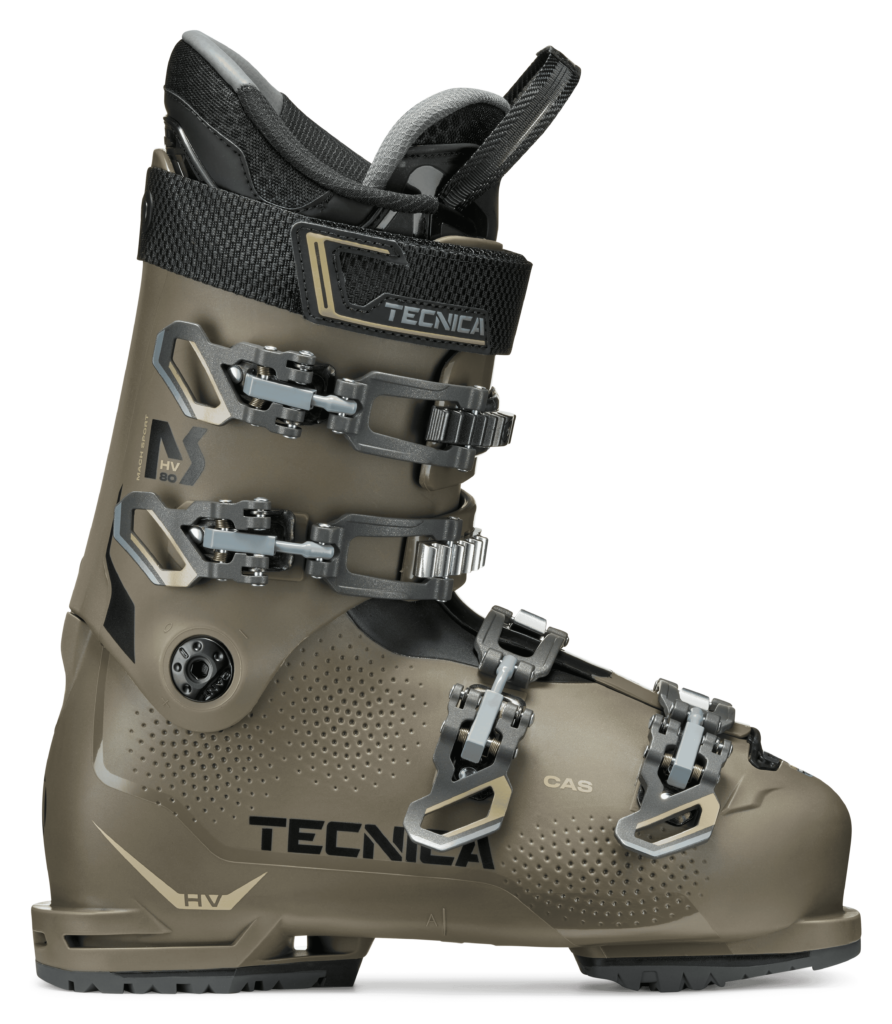
Boots comes in many different styles. Beginner boots often come with 3 buckles although others also have 4 buckles. The fit is more important than the number of buckles.
Almost all modern ski boots — beginner included — have a Velcro power strap at the top. For beginners, it’s for comfort and stability, not performance. It helps hold the shin comfortable. It should be snug, not tight.
Rear entry boots were popular in the 1990s. They are easy to put on but have poor control and fit compared to modern boots. If a rental shop only has rear-entry boots, it’s a red flag.
1.3 Bindings
Bindings attach your boots to your skis and release during a fall to reduce injury.
For beginners:
- Bindings are adjusted by weight, height, boot size, and ability
- Always have a technician adjust them
- Never adjust bindings yourself unless trained

1.4 Poles
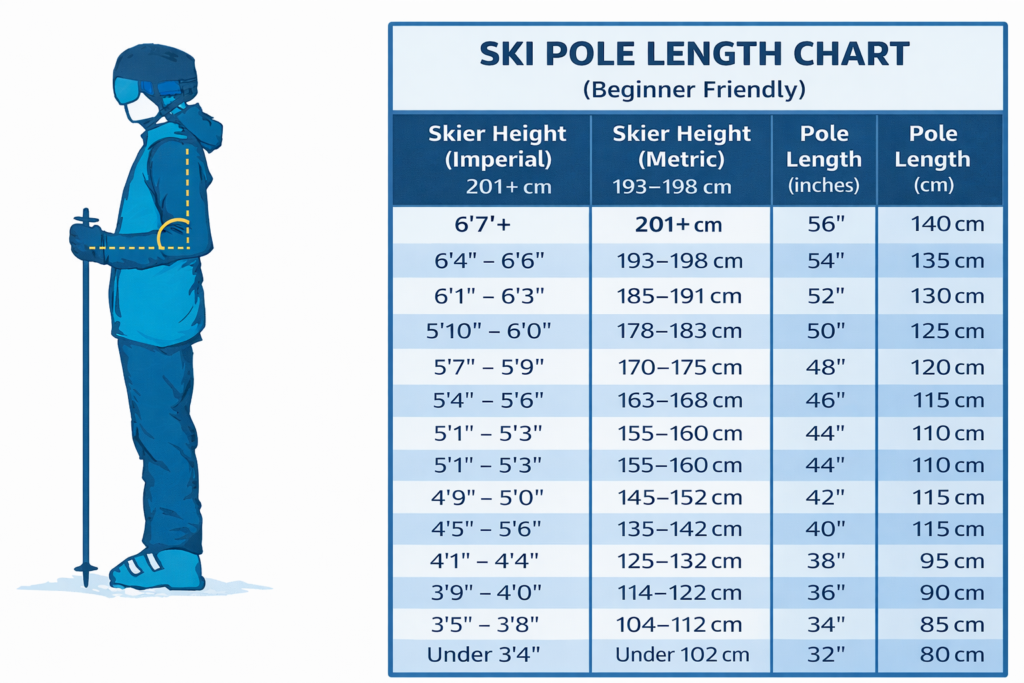
Beginners often don’t need poles right away. Poles help with timing turns (later) and flat terrain movement. Many ski schools teach beginners without poles at first. If you do get poles, use the below fitting guide as guidance. The key is to turn your pole upside down and place your hand under the basket. Your elbow should be at 90 degrees.
Chapter 2: Getting Ready to Ski
Good preparation makes learning easier and more enjoyable. Wearables can be broken down as follows:
2.1 What Rental Shops Provide (and What They Don’t)
Ski rental shops are set up to make it easy for beginners to get on the mountain. Every rental shop will provide the core ski equipment you need to ski:
- Skis
- Ski boots
- Ski poles
These items are always included in standard rental packages and are designed specifically for beginner use.
However, many rental shops do not provide ski wear or personal gear, such as:
- Helmets
- Goggles
- Gloves or mittens
- Ski Jackets and Pants
- Inner layers such as thermal shirt, socks, long underwear, etc.
- Other comfort items
Some shops do rent helmets, goggles, gloves, ski jackets and pants, but availability may be limited. You may be restricted to:
- Certain brands or models
- Basic styles and sizes
- What happens to be available on the day
Popular sizes can sell out quickly, especially during busy periods.
It’s a good idea to bring or purchase personal gear in advance, particularly:
- A helmet
- Goggles
- Gloves
- Inner layers
- Other comfort items
Rental skis and boots are perfectly fine for learning, but personal clothing and protective gear usually fit better, feel warmer, and make the day more comfortable.
2.2 Helmets for Beginners
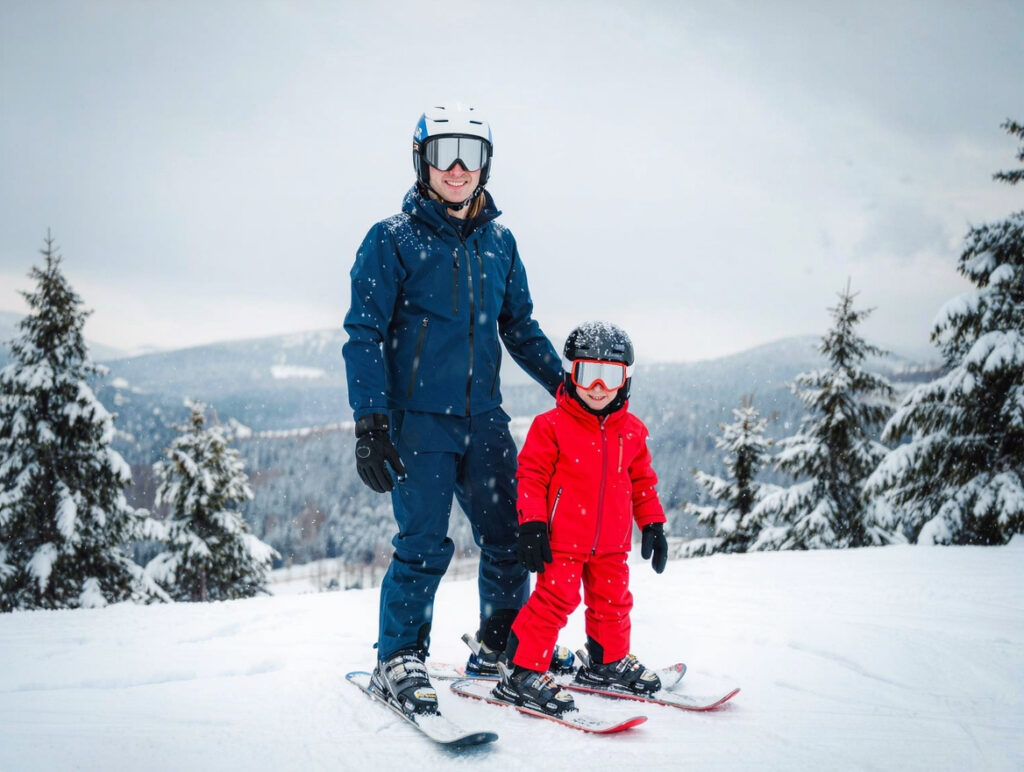
A helmet for beginners is more or less the same for experts. A helmet is strongly recommended for all skiers. You should wear a helmet that is certified as follows:
- ASTM F2040 (USA & Canada)
- EN 1077 (Europe & UK – CE or UKCA marked)
- CSA Z263.1 (Canada)
- AS/NZS 2063 (Australia & New Zealand)
A helmet only needs to meet one of these standards to be suitable for recreational skiing.
A rental helmet should:
- Sit level on your head (not tilted back)
- Cover your forehead (1–2 fingers above eyebrows)
- Feel snug all around without pressure points
- Not move when you shake your head
If it slides, wobbles, or feels loose → ask for a different size.
A helmet must have a workable chin strap (do not skip this). A chin strap should:
- Strap should be snug under your chin
- You should be able to fit one finger, not more
- Buckle should close securely and not slip
A loose strap makes the helmet far less effective.
2.3 Goggles for Beginners
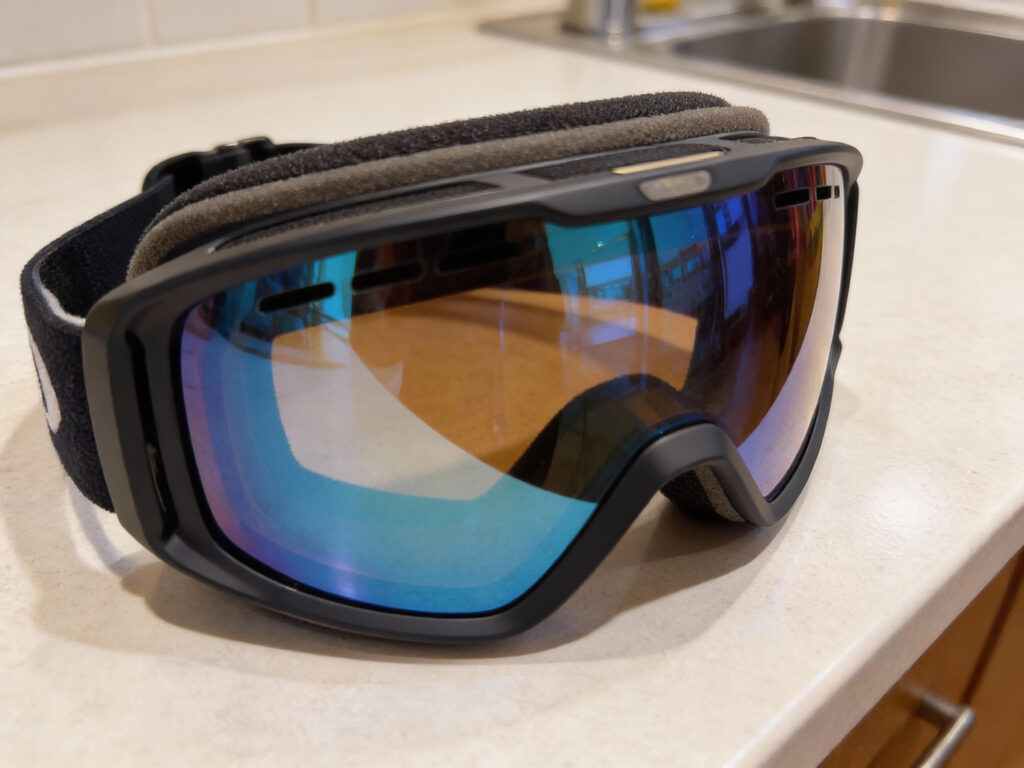
Protect your eyes from wind and snow. Even in cloudy days, you will be surprised how bright white snow can be in your eyes. You will not enjoy skiing at all without proper eye protection. We recommend goggle instead of sunglasses regardless of whether it’s a snowy day or a sunny day. Goggles seal around your face. They block the wind, snow, and ice. They prevent tearing and dryness and improve visibility in flat light. They also sit nicely between your helmet on your face.
Often, ski rental shops do not rent goggles (also gloves) so you may need to prepare them. When buying goggles, here are things to look for:
Visible Light Transmission (VLT): this tells you how much light passes through the lens. Beginners should prioritize higher VLT to it is easier to see the terrain.
Lens Color: Yellow / Gold are excellent in flat light. Rose / Pink boosts contrast in most conditions. Light Amber versatile and easy on the eyes. Dark gray or mirrored lenses can hide terrain details.
UV Protection: look for 100% UV protection or UV400. UV400 will should block about 99% of UVA and UVB. A dark lens does NOT mean it protects against UV.
Anti-fog Coating: Fogging is one of the biggest beginner frustrations. Look for Factory-applied anti-fog coating and Dual-lens construction (huge improvement).
2.4 Gloves or Mittens?
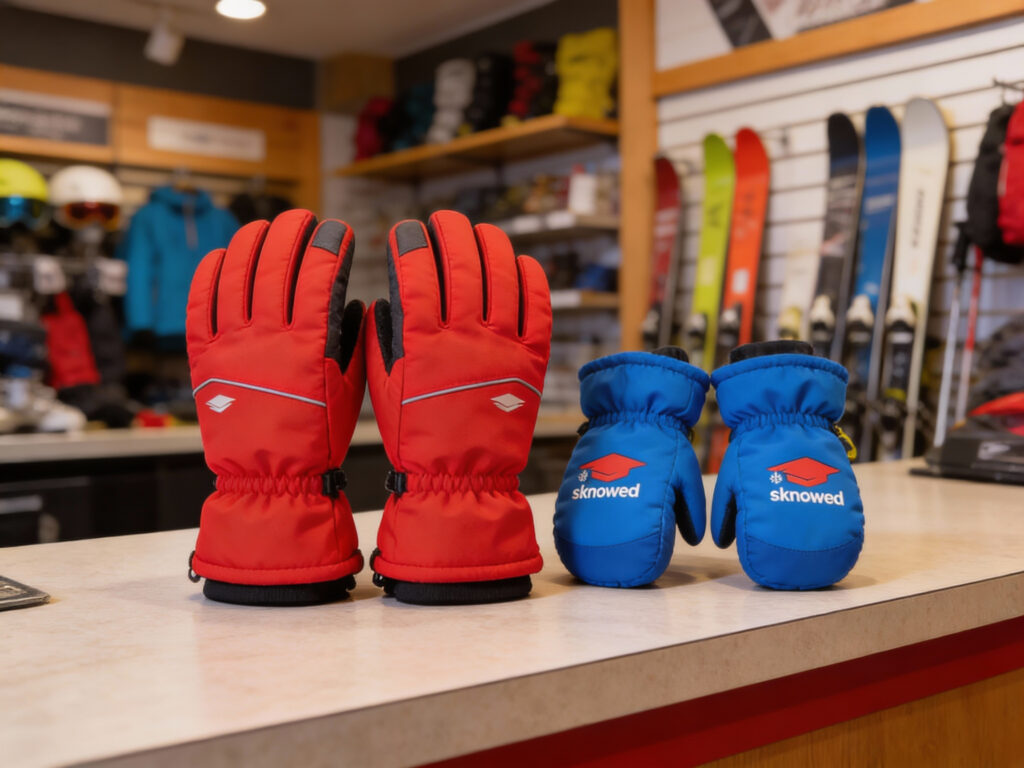
Keeping your hands warm and dry is essential for enjoying your ski day. Cold hands make everything harder — from holding poles to adjusting boots and bindings.
Both gloves and mittens work for skiing, but they have different strengths.
Gloves
Pros
- Better finger dexterity
- Easier to adjust buckles, zippers, and bindings
- Easier to hold poles and handle small items
Cons
- Fingers are separated, so they can feel colder
- Less efficient at retaining heat in very cold conditions
Gloves are great in mild to moderate weather for kids. If cold, switching to mittens may be preferable for kids. For adults, gloves are much more common that mittens.
Mittens
Pros
- Warmer than gloves
- Fingers share heat, reducing heat loss
- Great for cold, windy, or snowy days
Cons
- Less dexterity
- Harder to manage buckles, zippers, and small tasks
Best for
- Very cold climates and kids
Which are more common?
For beginners:
- Gloves are more common, especially for adults and in rental shops for beginner setups
- Mittens may be popular in colder regions and with kids but if the temperature is milder, you’ll enjoy the dexterity of gloves a lot more.
What to look for (gloves or mittens)
Regardless of which you choose:
- Waterproof or highly water-resistant
- Insulated
- Long cuff that goes over your jacket sleeve
- Secure wrist strap or closure
Optional but helpful:
- Add thin liner gloves (extra warmth and convenience)
2.5 What to Wear (Layering System)
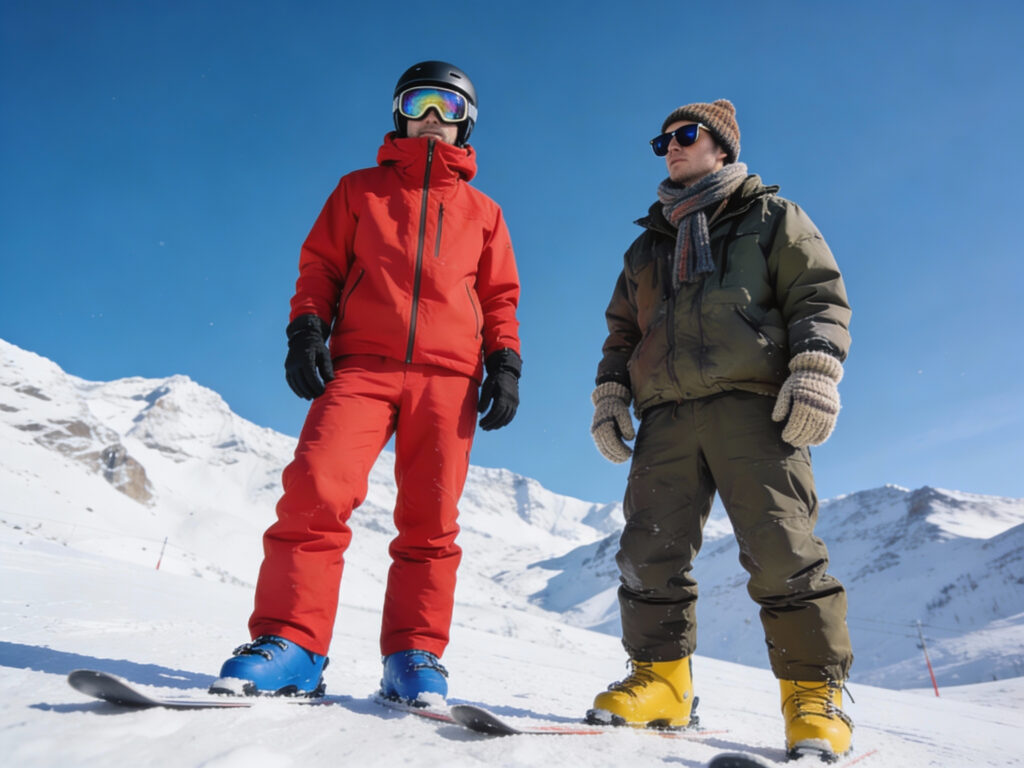
For skiing, think in layers. Not “big jacket,” but a system that manages cold, wind, moisture, and heat.
- Base layer – keeps sweat away from your skin and keeps you dry and warm. Look for merino wool or synthetic (never cotton).
- Mid layer – provides warmth by trapping heat. Use a fleece jacket, light down, or synthetic puffy
- Outer layer – block wind, snow and rain. No jeans or cotton layers. GORE-TEX is a great choice for ski clothing! Waterproof / breathable ski jacket and pants. Fully taped seams preferred. Look for: 10k/10k minimum, 20k/20k better. That “10k/10k” or “20k/20k” you see on ski jackets and pants is talking about waterproofing (first number) and breathability ratings (second number). 20K for the first number means it can hold a 10m column of water before water is forced through. 20k breathability means 20,000 grams of moisture can pass through one square meter of fabric in a day.
- 5,000 mm → leaks under light pressure
- 10,000 mm → handles steady snow & sitting on wet lifts
- 20,000 mm → handles heavy storms, kneeling, wet chairlifts
- 30,000 mm → extreme, professional-use level
2.6 What to Wear on Your Feet
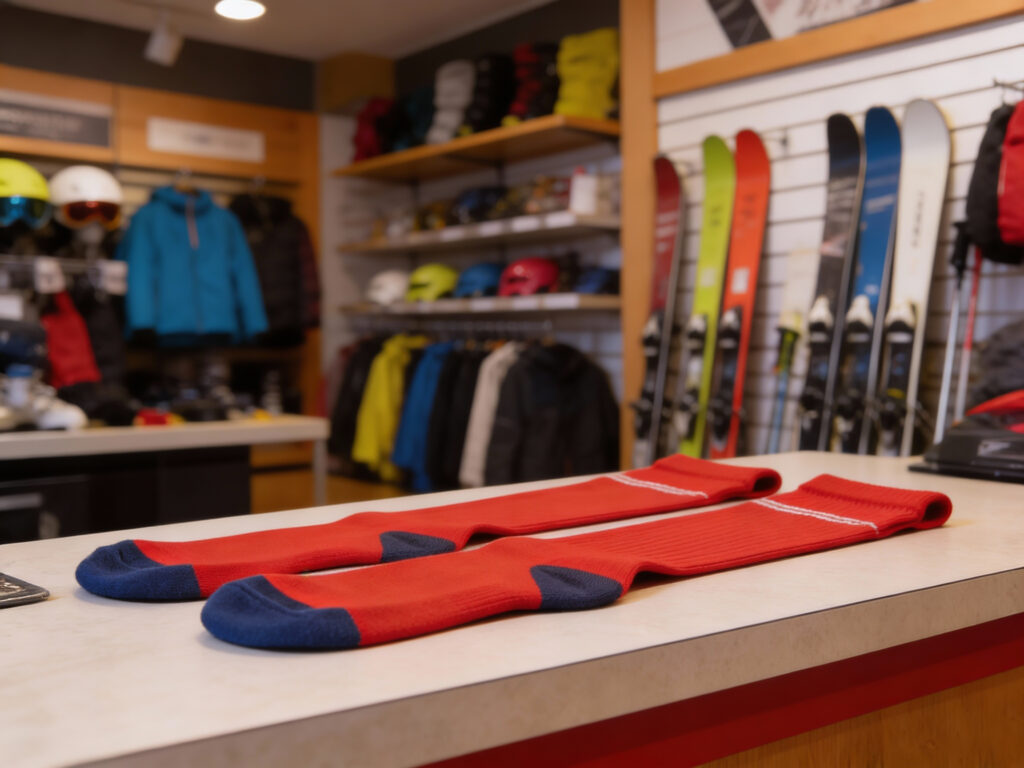
Keeping your feet warm and comfortable is critical. Cold or painful feet can quickly turn an enjoyable ski day into a frustrating one.
Ski Socks (Very Important)
- Wear one pair of ski socks only (do NOT double up).
- Socks should be:
- Thin
- Tall (over the calf)
- Made from merino wool or synthetic material
- Repeat, never double up socks
- Never wear cotton socks
Thick or layered socks reduce circulation and often make feet colder, not warmer.
Boot Fit Matters More Than Socks
Properly fitted ski boots matter far more than thick socks.
If your feet feel cold:
- It is often due to poor boot fit
- Boots may be:
- Too loose (cold air circulates)
- Buckled incorrectly
- Too tight in the wrong areas, restricting blood flow
Rental technicians fit boots all day — ask for adjustments if something feels off. Don’t “power through” foot pain.
Chapter 3: First Time on Snow
Let’s make sure your first moments on skis are calm and controlled.
3.1 Carrying Skis Safely
To carry skis:
- Hold both skis together with bindings facing out. Skis interlock with their bindings quite easily.
- Carry them on your shoulder or at your side
- Be mindful of people around you
3.2 Walking in Ski Boots
Ski boots are stiff and awkward by design. They’re built for skiing, not walking — so feeling unstable at first is completely normal.
Tips:
- Walk slowly
- Take short, flat steps
- Keep your feet slightly wider apart
- Use handrails on stairs and ramps
- Be extra careful on icy or wet surfaces
Everyone struggles with this at first. After a few minutes, it becomes manageable.
3.3 Putting Skis On and Taking Them Off
To put skis on:
- Place skis on flat snow
- Clear snow from bindings
- Put your toes in first and then step down in the heel until you hear a click
To take skis off:
- Use your pole or hand to press the binding release at the heel. It may take quite a bit of force.
Practice this a few times on flat ground.
3.4 Finding Balance
Stand with:
- Feet hip-width apart
- Knees slightly bent
- Hands in front of you
- Eyes looking forward
This is your athletic stance — relaxed, centered, and ready to move.
3.5 How Skis Move
Skis naturally want to:
- Slide forward
- Slide downhill
- Not stop on their own
This is why learning to control speed is your first priority.
3.6 Side-Stepping
Side-stepping helps you move uphill or reposition yourself.
How to side-step:
- Turn skis across the slope
- Dig edges into the snow
- Step uphill one foot at a time
This skill builds confidence early.
3.7 Herringbone (Walking Uphill)
To move uphill:
- Point ski tips outward
- Keep tails closer together
- Step forward using edges for grip
This looks like a fish skeleton — hence the name.
3.8 Getting Up After a Fall
Falling is part of learning.
To get up:
- Turn skis across the slope
- Pull knees toward your chest
- Push up using your hands or poles
- Stand slowly
Take your time. There is no rush. You can always take your skis off, stand up and then get back in them.
3.9 Your First Glide
On a very gentle slope:
- Let skis slide straight
- Stay relaxed
- Focus on balance, not speed
If you feel nervous, stop and reset.
Confidence comes from control, not bravery.
Chapter 4: The Snow Plow (Your First Skill)
The snow plow is the most important skill for beginner skiers.
It allows you to control speed, stay balanced, and stop safely.
If you learn nothing else at first, learn this.
4.1 What Is the Snow Plow?
The snow plow is a ski position where:
- Ski tips are closer together
- Ski tails are wider apart
- Skis form a V shape
This shape creates friction, which slows you down.
4.2 How to Make a Snow Plow
Start on flat ground or a very gentle slope.
- Stand in a relaxed athletic stance
- Gently push your ski tails outward
- Keep ski tips closer together
- Bend your knees slightly
- Keep hands forward and relaxed
The motion comes from your legs, not your upper body.
4.3 How the Snow Plow Controls Speed
- Wider plow → more friction → slower
- Narrower plow → less friction → faster
Speed control comes from pressure, not force.
Press gently down into the snow with both feet.
4.4 Common Snow Plow Mistakes
Avoid these early habits:
- Leaning back
- Locking your knees
- Pushing skis too wide
- Looking at your feet
Stay centered and relaxed.
4.5 Where to Practice
- Very gentle slopes
- Beginner learning areas
- Wide, uncrowded runs
You should feel in control at all times.
Chapter 5: Stopping Safely
Stopping is simply a stronger, more deliberate snow plow.
Before you ski faster or steeper terrain, you must be able to stop when you choose.
5.1 The Snow Plow Stop
To stop:
- Start in a snow plow
- Gradually widen the plow
- Press evenly on both skis
- Keep your body centered
- Come to a complete stop
Do not rush the stop. Smooth pressure works better than sudden force.
5.2 Emergency Stopping
If you feel out of control:
- Make your plow wider
- Sit slightly lower by bending knees
- Focus on staying balanced
Avoid sitting back or dropping to the ground.
5.3 Where to Stop on the Slope
Stop:
- At the side of the run
- Where you are visible from uphill
- In wide areas, not below rollovers
Never stop:
- In narrow sections
- Below blind spots
- In the middle of the slope
5.4 Safety Awareness
Always look uphill before starting again.
Downhill skiers have the right of way — but that does not remove your responsibility to stay in control.
Chapter 6: Turning Using the Snow Plow
Turning is how skiers control speed on longer slopes.
You do not turn by twisting your body — skis turn when they are edged and weighted correctly.
6.1 Why Skis Turn
Skis turn because:
- Edges grip the snow
- Pressure changes from foot to foot
- The ski shape helps guide the turn
Your job is to guide this process, not fight it.
6.2 Snow Plow Turns (Left and Right)
To turn left:
- Apply more pressure to your right ski
- Keep your left ski relaxed
- Maintain the snow plow shape
To turn right:
- Apply more pressure to your left ski
- Keep your right ski relaxed
The outside ski does more work.
6.3 Linking Turns
Once comfortable:
- Turn left
- Transition through a neutral plow
- Turn right
- Repeat smoothly
Turning across the slope controls speed naturally.
6.4 Body Position During Turns
- Face downhill
- Keep hands forward
- Stay relaxed
- Let legs do the work
Upper body stays quiet; legs guide the skis.
6.5 Common Turning Problems
If turns feel hard:
- You may be leaning back
- Your plow may be too wide
- You may be rushing the turn
Slow everything down.
6.6 Practicing Turns
Practice on:
- Wide beginner slopes
- Consistent terrain
- Short runs at first
Quality matters more than quantity.
And now put it all together! Learn how to ski in a day!
End of Chapter Reminder
Good skiing is controlled skiing.
You are not trying to go fast.
You are learning to:
- Control speed
- Choose direction
- Stop safely
Confidence comes from control.
Chapter 7: Riding the Lift
Using ski lifts can feel intimidating at first, but they are designed to be simple and safe. Once you understand the process, lifts quickly become routine.
7.1 Types of Beginner Lifts
Magic Carpet
A magic carpet is a moving conveyor belt.
- Step on with skis parallel
- Stand still and let it carry you
- Step off at the top and glide forward
This is the easiest lift for beginners.
Chairlift
Chairlifts carry skiers uphill while seated.
Before loading:
- Remove pole straps from your wrists
- Hold poles in one hand
- Line up when the lift operator signals
7.2 Loading the Chairlift
- Slide to the marked loading area
- Look over your shoulder
- Sit back as the chair arrives
- Keep skis pointed straight
Once seated, relax.
7.3 Riding the Chairlift
- Keep skis pointed forward
- Do not swing your legs
- Lower the safety bar, if available
- Enjoy the ride and observe the slope
7.4 Unloading the Chairlift
As you approach the top:
- Raise the safety bar. There is often signage reminding you of this.
- Keep skis straight
- Stand up smoothly when instructed
- Glide straight ahead and move away quickly
If you fall, stay calm and move to the side.
7.5 Lift Etiquette
- Follow lift operator instructions
- Be patient with other beginners
- If unsure, ask for help
Everyone learns at a different pace.
Chapter 8: Moving Beyond the Snow Plow
As your confidence grows, you will begin narrowing the snow plow and skiing more smoothly.
This is the bridge between beginner and intermediate skiing.
8.1 Narrowing the Plow
Gradually:
- Bring ski tails closer together
- Maintain balance
- Keep pressure controlled
The plow becomes smaller, but control remains.
8.2 Parallel Moments
You may notice brief moments where:
- Skis become parallel during turns
- Turns feel smoother
- Speed feels more controlled
This is progress, not a goal to rush.
8.3 When You’re Ready to Progress
You are ready to move on when you can:
- Stop confidently
- Control speed on green runs
- Link turns smoothly
- Ride lifts comfortably
If any of these feel shaky, stay at your current level.
8.4 The Value of Lessons
Professional lessons help:
- Correct bad habits early
- Improve confidence
- Speed up learning safely
Even one lesson can make a big difference.
Chapter 9: Skiing Safely
Ski resorts are shared spaces. Safety depends on everyone behaving responsibly.
9.1 The Skier’s Responsibility Code
As a skier, you must:
- Stay in control at all times
- Yield to people downhill
- Look uphill before starting
- Avoid stopping in blind spots and stop on the side of the run, not the middle
- Observe posted signs and warnings
These rules protect everyone.
9.2 Understanding Trail Signs
Trail difficulty is marked by:
- Green circle – beginner
- Blue square – intermediate
- Black diamond – advanced
Choose terrain appropriate to your skill.
9.3 Visibility and Weather
Poor visibility makes skiing harder.
Be cautious when:
- It’s foggy
- Snow is falling heavily
- Light is flat
Slow down and ski conservatively.
Sknowed.com offers both a 16 day long range forecast and shows snow also in the last 16 days. See see forecasts for various counties as follows:
Here is a typical forecast showing some of the variables covered including high, low temperatures, wind speed and gusts, snow accumulation, rain, freezing level and so forth.
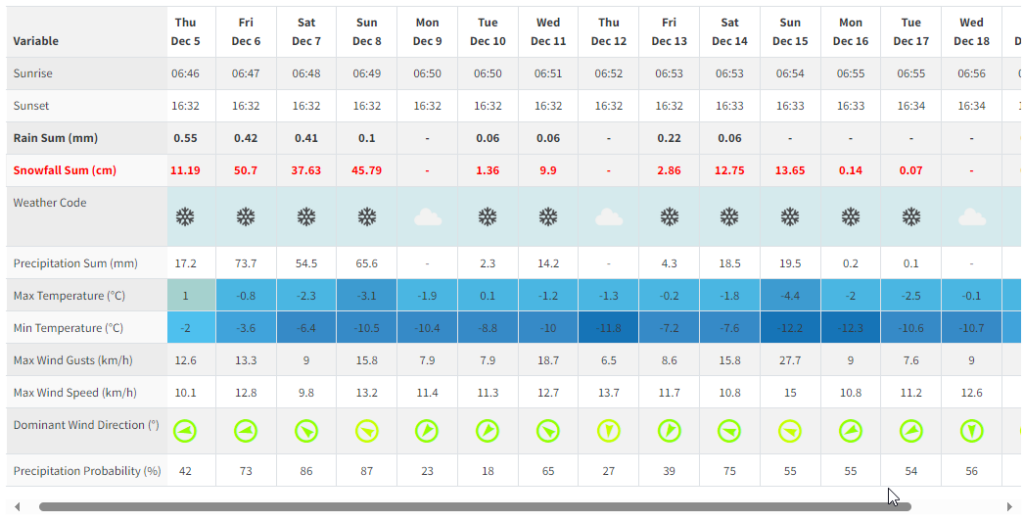
The weather forecast is based upon the Global Forecast Model (GFS).
9.4 Knowing When to Stop
Stop skiing if:
- Your legs are exhausted
- You’re making repeated mistakes
- Conditions are worsening
Fatigue increases injury risk.
9.5 Helping Others
If you see someone fallen:
- Stop safely nearby
- Ask if they are okay
- Notify ski patrol if needed
Never move an injured person unless necessary.
End of Chapter Reminder
Good skiers:
- Respect others
- Know their limits
- Make smart decisions
Skiing is more enjoyable when done safely.
Chapter 10: Common Beginner Problems (And Fixes)
Every beginner experiences challenges. These are not failures — they are part of learning.
Understanding why something is happening makes it much easier to fix.
“I Can’t Stop”
This usually means:
- Your snow plow is too narrow
- You’re not applying enough pressure
Fix:
- Widen the plow gradually
- Press down into the snow with both feet
- Stay centered, not leaning back
“My Legs Hurt”
Skiing uses muscles you may not be used to.
Fix:
- Take frequent breaks
- Ski shorter runs
- Focus on relaxed movement
- Check boot fit — tight boots increase fatigue
“I Keep Falling Backward”
This is a very common issue.
Fix:
- Bend ankles and knees
- Keep hands forward
- Feel pressure on the front of your boots
Your body should be stacked over your feet.
“I’m Scared on Steeper Slopes”
Fear is natural when terrain changes.
Fix:
- Return to gentler terrain
- Focus on turning across the slope
- Slow everything down
- Practice controlled stops
Confidence grows gradually.
“My Skis Cross or Get Stuck”
This often happens when the plow is too wide.
Fix:
- Narrow the plow slightly
- Keep movements smooth
- Avoid sudden force
Chapter 11: Learning Faster
Skiing improves fastest when practice is intentional.
Quality Over Quantity
A few focused runs are better than a full day of tired skiing.
Set small goals like:
- Controlled stops
- Smooth turns
- Staying relaxed
Practice Smart
- Ski early in the day when snow is firmer
- Choose uncrowded runs
- Repeat the same run to build confidence
Use Feedback
Watching yourself ski helps more than you expect.
Options include:
- Filming short clips
- Watching others at your level
- Asking for advice
Lessons at the Right Time
Lessons are especially helpful when:
- You feel stuck
- You’re developing bad habits
- You want to move beyond the snow plow
One lesson can save many days of frustration.
Mental Approach
Progress is not linear.
Some days feel harder than others. This is normal.
Stay patient and positive.
Chapter 12: Your First Full Ski Day
Putting everything together makes skiing truly enjoyable.
A Sample Beginner Ski Day
Morning
- Arrive early
- Warm up on flat terrain
- Review snow plow and stopping
Midday
- Practice snow plow and linking turns
- Ride the lift comfortably
- Take breaks often
Afternoon
- Choose familiar runs
- Ski smoothly, not aggressively
- Stay in control
- End before exhaustion sets in
Warm-Up Routine
Before your first run:
- Flex ankles and knees
- Practice snow plow on flat ground
- Take a short glide
This prepares your body and mind.
Choosing Runs
Stick to:
- Wide green runs
- Familiar terrain
- Consistent slopes
Avoid rushing into harder runs.
Ending the Day
End your day:
- While you still feel in control
- With energy left
- On a positive note
This builds confidence for next time.
Looking Ahead
As you continue skiing:
- Turns become smoother
- Control feels natural
- Speed becomes less intimidating
You are no longer just surviving — you are skiing.
Congratulations
You now have the foundation to ski safely and confidently.
Skiing is a lifelong skill.
Take your time.
Enjoy the mountains.
“Skiing is a dance, and the mountain always leads.” – Stein Eriksen